Material note
The 40-Square-Meter Order I Almost Got Wrong: A Quality Manager's Story on Fabric Specs and Small Clients
Posted 2026-11-20 by Jane Smith
In October 2023, a fabric sample landed on my desk with a sticky note from our Spanish distributor: "Client asked if they can use lyocell for an outdoor shade. 40 square meters. I know it's small, but they've been struggling to get straight answers."
I've been the quality and compliance manager at Serge Ferrari for just over four years. I review fabric specifications before they reach customers—roughly 200 inquiries a year across shade, tensile, and furniture applications. Most are straightforward. I've rejected maybe 8% of first deliveries in 2024 for spec mismatches—samples that looked right but failed on paper. This one had a story behind it.
The small-order problem
The client was a three-person design studio working on a boutique hotel's courtyard restaurant in Valencia. The shade structure covered about 40 square meters—barely enough to register on most vendors' radar, as the distributor's note implied. But the question was reasonable. They'd used lyocell fabric for indoor soft furnishings and liked how it hung. Why not use it outside?
Before I got to the technical answer, I asked for context. Turned out they'd been calling around for two weeks. Most suppliers wouldn't return their calls once they heard the quantity. One told them to "come back when the order was bigger."
I believed it. Minimum order quantities in technical textiles are real. A 40-square-meter order doesn't fit neatly into most production schedules. But I've been on the receiving end of that attitude too. When I started in QA, I had a $300 order rejected by three vendors before one took it seriously. Two years later, that same vendor got our $45,000 annual contract. Small doesn't mean unimportant. It means potential.
The lyocell question
Back to the fiber. I'm not a polymer chemist, so I can't speak to the molecular differences between lyocell and viscose at the fiber level. What I can tell you from a quality inspection standpoint is what the test data says.
Lyocell fabric characteristics are well-documented: high wet strength, good moisture management, soft hand feel. It's a genuinely excellent fiber for apparel and indoor furnishings. But outdoor shade has a different requirement set. Lightfastness matters more than drape. Dimensional stability under UV exposure matters more than breathability.
Viscose—what most people mean when they say "rayon"—has similar limitations, only more so. Viscose loses roughly 40–50% of its dry strength when wet, depending on the specific process, and its lightfastness rating typically tops out around 4–5 on the Blue Wool Scale. For permanent outdoor shade in direct Mediterranean sun, industry practice calls for a minimum of 6–7. That gap isn't a matter of opinion. It's measurable.
The sample I almost approved
Here's where I almost made a mistake.
The client had also sent a sample from another supplier—a woven fabric marketed as "outdoor suitable." I looked at it, felt the hand, and said something like, "This seems fine." That was careless. I hadn't asked for the spec sheet yet. I hadn't seen the lightfastness test report.
Four days later—actually, closer to six, because the supplier kept "checking with the factory"—the full documentation arrived. Lightfastness rating: 5. The supplier had described it as "within industry standard." And technically, they weren't lying. There's no single universal standard for "outdoor fabric." There's a range of standards depending on application, region, and testing protocol. But the gap between "meets some outdoor standard" and "meets the standard for permanent outdoor shade in Southern Europe" is significant.
I called the distributor and said, "Don't specify that fabric for this project." Then I called the client directly—something we don't usually do for a 40-square-meter order. But I wanted her to hear the reason from me, not filtered through a purchase order.
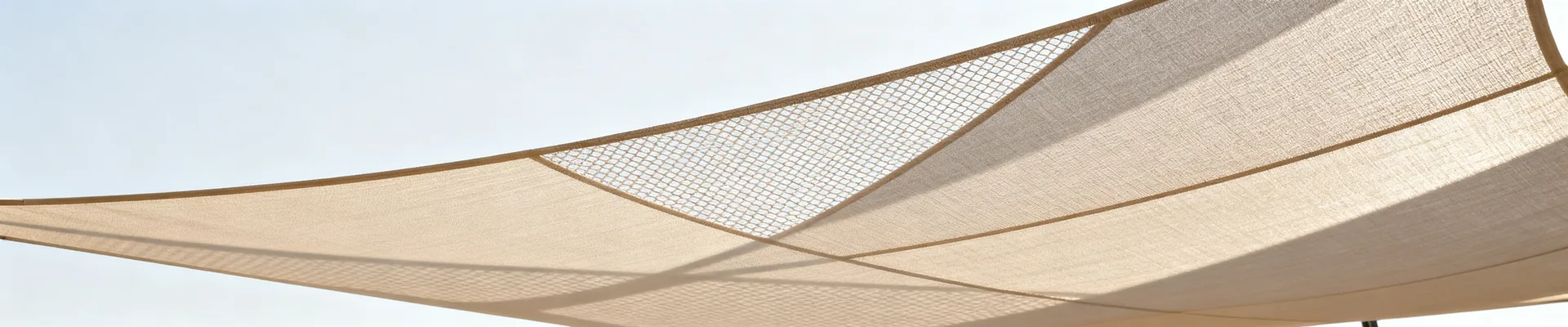
We ended up specifying Serge Ferrari Soltis Proof 502 for the shade structure. Not because it was the cheapest option or the one with the flashiest brochure—but because the spec sheet actually matched the application. Proof 502 has a lightfastness rating of 7–8 on the Blue Wool Scale, and its dimensional stability under tension is well-documented for permanent installations.
The broader Serge Ferrari Soltis range is engineered for exactly this use case: tensile shade structures where the fabric holds tension for years without excessive creep or color shift. Proof 502 adds a waterproof coating for rain exposure—though I should note that "waterproof" here means resistance to rain penetration under specified test conditions, not a guarantee against every possible weather scenario.
Even after we settled on Proof 502, I kept second-guessing. What if the client's site had more reflected UV than we estimated? What if the installation team didn't tension it correctly? The two months until we got photos back from the finished restaurant were stressful. When they arrived, the shade looked exactly as specified. No fading, no sagging. I finally relaxed.
Never expected the part of this project that would surprise me most wasn't the fabric choice—it was how closely the client had been paying attention. She asked for the test reports. Not because I offered them, but because she'd been burned before by an interior designer who specified a "premium" textile that faded within six months.
That changed how I approach small orders now. Not because small clients are more demanding—they usually aren't. But because they have fewer resources to absorb a mistake. A hotel chain with 200 properties can eat the cost of redoing one terrace. A three-person studio can't.
What I do differently now
Looking back, I should have asked for the full spec sheet before opening my mouth. At the time, the sample felt right. It looked right. But "looks right" isn't a quality standard. It's a guess.
The fix was simple: now every order, regardless of size, goes through the same three-step verification before I say a word to the client. First, I get the full spec sheet from the supplier—not a marketing summary. Second, I check third-party test data for lightfastness, tensile strength, and tear resistance. Third, I test a physical sample myself, even if it's just a visual check under controlled lighting. This worked for us, but our situation was a 40-square-meter installation with partial shade and temperate UV exposure. If you're specifying for full-sun desert conditions or a 10,000-square-meter tensile structure, the requirements change—and so should your verification protocol.
The one thing that shouldn't change: the size of the order shouldn't determine the level of scrutiny. A $400 order and a $40,000 order deserve the same spec sheet.

Jane Smith
I’m Jane Smith, a senior content writer with over 15 years of experience in the packaging and printing industry. I specialize in writing about the latest trends, technologies, and best practices in packaging design, sustainability, and printing techniques. My goal is to help businesses understand complex printing processes and design solutions that enhance both product packaging and brand visibility.